














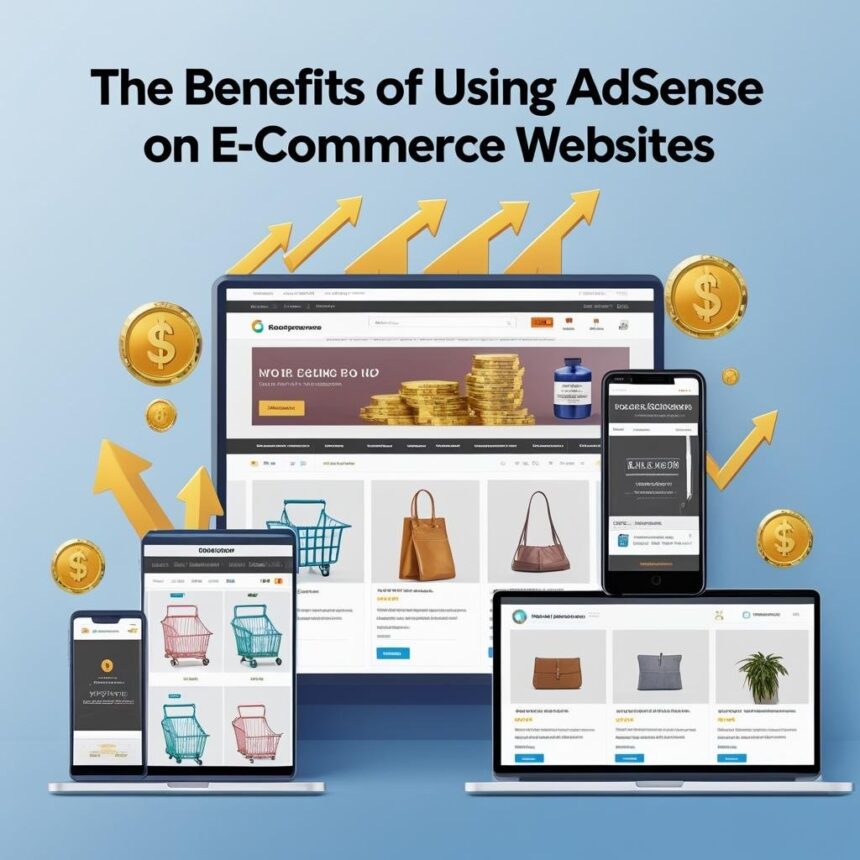
I Thought It Was a Crazy Idea, But Here Are the Surprising Benefits of Using AdSense on E-commerce Websites
The number on the screen felt like a personal insult. “Abandoned Carts: 27.”
Twenty-seven. That’s how many people had put one of my products—products I had designed, sourced, and poured my soul into—into their shopping cart on my little e-commerce website yesterday, only to just… leave.
It’s a special kind of gut punch that only fellow online store owners can understand. It’s like having 27 people walk up to the register at your physical shop, put an item on the counter, look you right in the eye, and then just turn around and walk out without a word.
I felt so defeated. My traffic was decent. People were visiting. But my sales? They were just enough to cover my costs and not much else. I was treading water, and I was getting tired.


That night, feeling frustrated and desperate, I was scrolling through a forum for online sellers. And someone mentioned an idea that seemed, at first glance, like the single dumbest thing I had ever heard. They talked about exploring the benefits of using AdSense on e-commerce websites.
My first reaction was visceral. Ads? On my store? Are you kidding me?
Why would I ever put random, distracting ads on the very website where my one and only goal is to sell my own products? It felt like putting a McDonald’s billboard inside your own five-star restaurant. It was heresy.


But desperation is a powerful motivator. I couldn’t shake the idea. And that night, I tumbled down a rabbit hole that fundamentally changed how I think about my online store, my customers, and what it really means to run a business on the internet.
I’m no marketing guru. I’m just a regular person with a little online shop who was tired of feeling like a failure. This is the story of my reluctant journey into a very controversial idea.
My First Confusing Steps Into the World of Storefront Ads
So there I was, embarking on a research mission that felt deeply wrong. My search history was full of phrases like “AdSense on e-commerce site good or bad” and “am I crazy for putting ads on my own store.”
The initial results were not comforting. I found a hornet’s nest of opinions. I’d read one article from a marketing “expert” saying it was the worst mistake you could ever make. A cardinal sin. Then, I’d find another post in a forum where a small shop owner claimed it was the best decision they ever made.
It was a whirlwind of contradictions. The jargon was intense. People were throwing around terms like “conversion rate optimization,” “average order value,” and “customer lifetime value.” It felt like I needed an MBA just to understand the arguments. It seemed like this was one of those topics where everyone had a fiery, passionate opinion, but nobody could really agree on a simple yes or no.
Drowning in a Sea of Conflicting Advice
My biggest struggle at first was just trying to wrap my head around the core benefit people were claiming. They kept talking about it as an additional revenue stream. Well, duh. That’s what ads do. But it seemed so small. The pennies you might earn from a few ad clicks felt like a pathetic consolation prize compared to the profit from an actual sale of one of my products.
The other phrase that kept popping up was monetizing non-converting traffic. This sounded a bit more interesting, but it was still fuzzy. What did that actually mean? So, for the 98% of people who visit my site and don’t buy anything, I can make… a few cents off them? It still felt like picking up pennies in a parking lot instead of focusing on the much bigger prize inside the store.
My first attempt to understand this was a failure. I actually went so far as to turn on Auto Ads on my site for one day. Just to see what would happen. It was a disaster. Ads were everywhere. They were popping up on my product pages, right next to the “Add to Cart” button. It looked horrible, it felt spammy, and I swear my sales for that day were even lower than usual. I turned it off in a panic after just a few hours, convinced the naysayers were right.
The ‘Corner Store’ Analogy That Opened My Eyes
I was ready to abandon the whole idea. It was clearly a desperate, amateur move that would hurt more than it helped. But one comment on an old blog post stuck with me. The person wrote, “Not everyone who walks into a library is there to check out a book. Some people are just there to read the magazines for free.”
And that got me thinking. I needed a better analogy. My “McDonald’s in a five-star restaurant” idea was too simple. It was wrong.
Here’s the analogy I finally landed on. Imagine you own a charming little corner store. You specialize in selling beautiful, high-end, artisanal coffee beans. That is your main business. Now, you notice that a lot of people come into your shop every day just to ask for directions. Or to use your free Wi-Fi. Or just to browse while they wait for the bus, with no intention of ever buying your expensive coffee beans. They are “non-converting traffic.”
What do you do? You could get angry and kick them out. “This is a store for buyers only!”
Or… what if you rented out a tiny little corner of your shop to a guy who sells newspapers and magazines? You don’t sell newspapers, so he’s not a competitor. The people who were never going to buy your coffee might buy a newspaper. The guy pays you a little rent for the space. Suddenly, you’re making a little bit of money from the people who were previously giving you nothing. And it doesn’t stop the coffee lovers from buying their beans.
AdSense on my e-commerce site wasn’t about putting McDonald’s in my restaurant. It was about putting a newspaper stand in my specialty coffee shop.
This single, simple idea changed everything. It made me realize that I was wrong about a lot of my most deeply held beliefs about how my store should work.
Turns Out, I Was Thinking About My Online Store All Wrong
Armed with my new “newspaper stand” analogy, I started to feel a surge of confidence. The idea wasn’t completely insane after all.
But that confidence also illuminated just how many myths I’d been clinging to. I was operating under a set of rules I had created for myself based on fear and assumptions, not on data or strategy. I was thinking like a shop owner, but I wasn’t thinking like a website owner.
The benefits of using AdSense on e-commerce websites weren’t just about making a few extra bucks. From what I was reading, it was part of a much bigger, more nuanced strategy. To get there, I had to dismantle some of my own bad ideas.
The Big, Scary Monster: “Won’t It Just Show Ads for My Competitors?”
This was myth number one. The absolute biggest fear, and for good reason. Why on earth would I let Amazon or my direct competitor advertise on my site and poach my customers? That would be suicide.
And if you just blindly turn on AdSense with no configuration, yeah, that could happen. This is the big scary story that most people tell.
But this is where I discovered my fear was based on outdated information. The reality is, Google gives you a surprising amount of control. Inside your AdSense account, there’s a whole section for “Blocking controls.” You can block specific advertiser URLs. So, I can literally make a list of all my known competitors and just tell Google, “Nope. These guys are never allowed to show an ad on my site.” Problem solved.
But you can go even deeper. You can block entire categories of ads. If I sell artisanal coffee, I can block the entire “Food & Groceries” category if I want to be extra careful. I can block ads based on their content, their destination, anything. Google’s own help documentation is actually pretty clear about how to do this. It’s not some hidden secret. Here’s a direct link to their guide on it, which became my bible for a few days: (Google AdSense Help: Review and block ads on your site).
Once I realized I had a big “block” button for showing competitor ads, the biggest monster under my bed was gone. It turned out to be just a shadow.
The Myth That It Has to Ruin the “Shopping Experience”
My next big hang-up was about the aesthetics. The feel of my store. I had worked so hard to make it clean, beautiful, and easy to navigate. I was terrified that ads would make it look cheap, spammy, and untrustworthy. A terrible user experience on e-commerce sites is a real business killer.


My disastrous first experiment where I just turned everything on had confirmed this fear. It did look awful.
But that was because I had used a sledgehammer when I needed a scalpel. I started learning that you don’t have to just let AdSense run wild. You can be incredibly strategic about where ads appear. You can choose which types of pages ads will show on. You can choose how many ads will show up.
This was a huge revelation. I didn’t have to put ads on my product pages. I didn’t have to put them on my checkout page. I could choose to only show ads on my blog posts or my informational guides. The places where people were “reading magazines,” not actively shopping for my coffee beans.
I realized I could have the best of both worlds. A clean, ad-free shopping experience for my buyers, and a gently monetized experience for my browsers. It wasn’t an all-or-nothing choice.


That “Every Visitor Is a Potential Buyer” Fallacy
This was the most subtle, but maybe the most important, myth I had to bust for myself. I was obsessed with my conversion rate. I treated every single visitor as a potential sale that I was either winning or losing. Every person who left without buying felt like a personal failure.
This is a terrible way to think. It’s just not true. The reality is, most people who visit your website—especially if they come from a search engine—are not ready to buy. Not even close.
They are in research mode. They’re learning. They’re comparing. They’re just curious. They might be a student doing a project on your industry. They might be another blogger looking for inspiration. They might have clicked a link by accident.
Treating every one of these people as a “failed sale” is madness. It was burning me out. I started to understand that my website had multiple jobs to do, not just one. It had to sell, yes. But it also had to inform, to educate, and to build a community. And it was okay for different parts of my site to serve these different purposes.
The Lightbulb Moment That Tied It All Together
So I was making progress. I felt like I had debunked the big scary myths. The idea was starting to feel less crazy and more… strategic.
But all the pieces hadn’t quite clicked into a single, cohesive picture yet. I understood the individual benefits, but I didn’t have a grand unified theory for my own store. The real breakthrough came when I stopped thinking about my website as a “store” and started thinking about the people who visited it. Who were they? What did they want? Why were they here?
And that led me to the concept that changed everything: Customer journey mapping.
I Was Treating Every Visitor the Same, But They Weren’t on the Same Road
I know, that sounds like more boring marketing jargon. But let’s just ignore the fancy name. The idea is dead simple.
Not everyone who comes to your website is on the same path. They’re all on different roads, heading to different destinations.
Before, I was acting like my website was just a single, straight road that ended at a cash register. And I was yelling at anyone who got distracted or decided to turn around.


But that’s not what my website was. I finally realized my website was more like a small town. In my town, there’s a Main Street with my shop on it (my product pages). This is where people who are ready to buy go. It’s for “commercial traffic.”
But my town also has a public library (my blog posts). It has a park with a nice fountain (my “about me” story). It has a tourist information center (my buying guides and how-to articles). These areas serve a different purpose. People come here to learn, to relax, to research. They might not be ready to go to Main Street today. And that’s okay.
My big “aha!” moment was realizing I can treat these different parts of my town differently. Main Street should be pristine, beautiful, and focused entirely on making a sale. No distractions.
But the library? The information center? It’s perfectly fine to have a little newspaper stand or a coffee cart in there. It can have its own little economy. For a deeper dive into this content-first philosophy, you should check out a post I wrote about how my blog accidentally became my best sales tool.
Monetizing Intention, Not Just Transactions
This new “small town” metaphor was my ultimate breakthrough. It completely re-framed the entire purpose of AdSense for me.
I stopped thinking about monetizing “people” and started thinking about monetizing “intention.”


What is the user’s intention when they land on a specific page? If they land on a product page for my “Artisanal Dark Roast Coffee Beans,” their intention is very likely commercial. They are thinking about buying. Showing them an ad is a distraction from that mission. It’s bad for them, and it’s bad for me.
But if they land on my blog post titled “The Top 5 Ways to Brew Coffee at Home,” their intention is informational. They are in learning mode. They are looking for ideas. They are “reading the magazines.” Placing a relevant ad—maybe for a coffee grinder, or a brand of water filter—in the middle of that article isn’t nearly as intrusive. It might even be helpful. It’s a natural fit for their informational journey.
I finally understood. The benefits of using AdSense on e-commerce websites are not about slapping ads everywhere. It’s about being a savvy “town planner.” It’s about understanding the different needs of your visitors in different locations and serving them—and your own business goals—accordingly.
My Unofficial, No-Nonsense Guide to Actually Doing This
Okay, so enough with the analogies. What did I actually do? How did I go from this theoretical understanding to actually implementing it on my site without ruining everything?
More Read


I developed a slow, careful, and very specific system for myself. A playbook. Again, I’m not an expert, this is just my cobbled-together process that took me from being terrified of ads to being a strategic user of them. Maybe my little checklist can help you too.
Step 1: I Built a Moat Around My “Main Street”
This is the most important rule. It is non-negotiable. My core shopping experience must be protected at all costs.
How I Do It: I use my ad management settings to explicitly exclude ads from showing up on certain pages. This includes every single one of my product pages, my category pages, my shopping cart page, and the entire checkout process.
The Action: This ensures that when a customer is in “buying mode,” their focus is 100% on my products. No distractions. No friction. No exit ramps that lead them away from the sale. It keeps my beautiful shop a beautiful shop.
Step 2: I Turned My “Library” into a Gentle Moneymaker
My blog and informational guides—my content marketing for online stores—is where I decided to deploy ads. This is my “newspaper stand.”
How I Do It: I enabled AdSense auto ads for retail sites, but only for these sections of my site. Auto ads are great because they use Google’s machine learning to try and find the best places to put ads. But I don’t give it free rein. I review the placements and dial down the number of ads if it feels like too much.
The Action: This strategy monetizes the informational-intent visitors—the people who were probably never going to buy something today anyway. It turns my content marketing from being purely a cost center into a small but consistent revenue generator. And this additional revenue helps pay for my hosting, my marketing tools, and the time it takes to write the content. It’s a self-funding content engine. Reputable sources like BigCommerce have great articles about the value of content marketing in e-commerce that reinforce this strategy. (BigCommerce Blog: Content Marketing for E-commerce).
Step 3: I Put Up a ‘No Competitors Allowed’ Sign
This is the nuts-and-bolts part that lets me sleep at night. I am relentless about blocking my competitors from showing up on my site.
How I Do It: I regularly use the “Advertiser URLs” blocking tool in AdSense. I have a list of my direct competitors and major online marketplaces, and I add them to my block list.
The Action: This is a simple but critical step. It gives me peace of mind knowing I’m not accidentally sending my hard-earned visitors directly into the arms of my competition. It’s a core part of being a responsible ad publisher on an e-commerce site. For my own process, I have a checklist I run through every month.
Step 4: I Watch the Data Like a Hawk
This isn’t a “set it and forget it” kind of thing. It’s an ongoing experiment.
How I Do It: I pay close attention to my AdSense reports, but I also watch my own e-commerce analytics like a hawk. I look at the bounce rate and time-on-page for my articles with ads. I monitor my conversion rates.
The Action: If I see that adding ads to a certain type of post is causing people to leave more quickly, I’ll dial back the ads or remove them entirely. It’s a constant balancing act between the user experience and the additional revenue. Google Analytics is a powerful free tool for this, and their free Analytics Academy has fantastic courses that teach you how to track this kind of engagement. (Google Analytics Academy). This is how I ensure my little newspaper stand never starts annoying my coffee customers.
So, Am I an Ad-Covered Sellout Now?
I have to laugh when I think about how fiercely I was against this idea at the beginning. It felt so pure to have a store with no ads.
But my “purity” was also leading to burnout and frustration. So am I a sellout? I don’t think so. I feel more like a savvy business owner. I have two types of customers now: the ones who buy my products, and the ones who “pay” for my free content by seeing a few carefully placed ads. Both are valuable. And together, they are building a much more resilient, sustainable business.
The small amount of money I make from AdSense isn’t going to make me rich. But it does something more important. It pays for my email marketing software. It covers my website hosting fees. It turns my content from an expense into an asset.
It takes some of the pressure off. It means every single visitor doesn’t have to be a sale. It gives me the freedom to create more helpful guides and articles, knowing they are contributing to the business even if they don’t lead to a direct conversion.
This whole journey started with me feeling like a failure. It ended with me understanding my own business on a much deeper level.
And it leaves me with a question I’m still pondering.

What other “sacred rules” are we following in our businesses that might be based more on fear than on strategy?