
















I Got That Hateful AdSense Rejection Email. Here’s the Real, Messy Story of Why.
My stomach clenched before I even opened the email. You know the feeling. The one where you’re hopeful, but your gut is already whispering, don’t be an idiot, you know how this ends.
The subject line was so neutral. “Your AdSense application status.” So harmless.
I clicked. And the world went a little gray. “…does not meet our program criteria.” “Policy violation(s) found.”

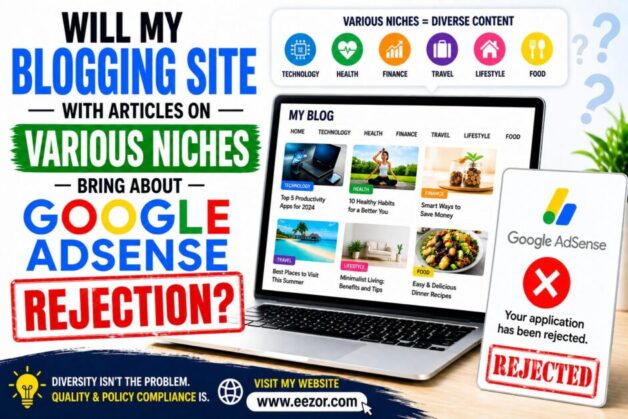
That was it. No explanation. No specifics. It was like getting a speeding ticket that just said, “You drove wrong.” Thanks. Super helpful. I felt a hot flash of anger, followed immediately by a wave of embarrassment. My little dream of making ten bucks a month from my blog just evaporated.
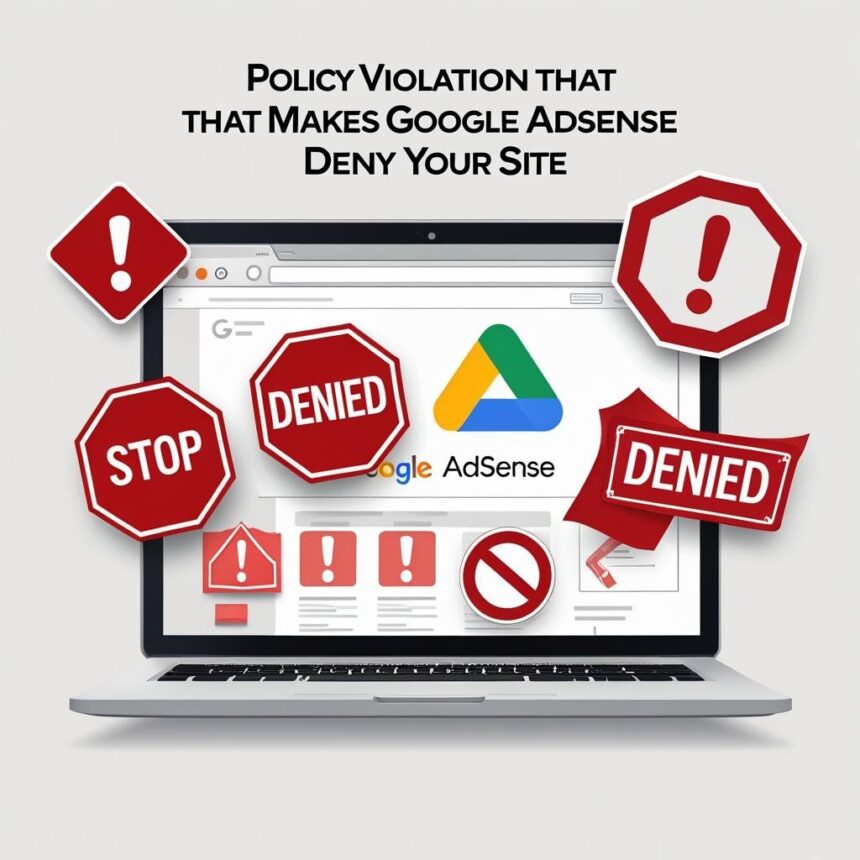
It sent me on a week-long spiral. I was obsessed. I was going to find out the very policy violation that makes Google AdSense deny your site approval if it was the last thing I did.
This is not an expert guide. I am not an expert. This is the diary of a madman. This is the story of someone who got that same soul-crushing email and went completely off the deep end trying to figure out what it meant.
If you’re here, you probably got one too. I’m sorry. It sucks. Let’s talk about it.
Down a Rabbit Hole Lined with Tech-Bro Jargon
My first move was to frantically Google the phrase “AdSense policy violation.”
Don’t do this. I’m begging you.

It’s like yelling “Is anyone out there?” into a canyon and having a million indecipherable echoes come back at once. I was buried in ancient forum threads, blogs written by people who clearly loved the sound of their own typing, and so, so many conflicting opinions.
It was a nightmare. One guy said my traffic was too low. Another said my logo was ugly. A third swore it was because my posts weren’t all over 2,000 words. I started to feel like I was trying to solve a riddle posed by a sphinx who only spoke in acronyms.
I just wanted to write about my houseplant collection, and suddenly I was supposed to understand things like CPC, RPM, and the entire Greek alphabet of Google Analytics metrics. It was just too much.
My Writing Was Apparently “Low-Value”? Ouch.
The phrase I kept seeing that really stung was low-value content. It just sounds so judgmental, right? Like a snobby art critic looking at my macaroni art and sneering. “Low-value.” But the more I read, the more I started to understand what it meant, and the more my stomach sank. I went back and looked at my earliest blog posts. And… yikes.
A lot of them were just short, diary-like entries. “My thoughts on Monday.” A 250-word post about a coffee I tried. There was no real information, no unique take, no story that would actually help anyone. It was content for me, not for a reader.
It was the blog equivalent of junk mail. And Google, I was starting to realize, doesn’t want to deliver junk mail. This was the first hint that the problem wasn’t one tiny mistake, but the entire foundation of my site. A terrifying thought.
So I Read the Rules, and My Brain Melted
Okay, I thought. I’ll be an adult. I’ll go to the source. I’ll read the official Google Publisher Policies.
This was, somehow, even worse.
Have you ever tried to read a software license agreement? It was like that, but for my entire creative soul. It was a masterclass in corporate doublespeak. It used big, vague phrases like “rich and meaningful user experience” and “significant original content.”
What does that even mean?! I thought my content was original! I thought my user experience was fine!
It was like asking someone for directions and they just say, “Head toward the nice-looking part of town.” I had no map. I had no compass. I was just sitting there, reading the same sentence five times, and my brain was slowly turning into scrambled eggs.
I left the official policies page more confused and demoralized than when I started. It felt completely hopeless.
The Mountain of Bad Advice I Had to Unlearn
At this point, I was just flailing. I was desperate and willing to try anything. I went back to the forums and started following every piece of advice I could find, no matter how weird it sounded.
This was a huge mistake. I now believe that half the battle of getting approved is learning to ignore 90% of the advice out there. So much of it is just plain wrong, based on rumors or outdated information. I had to unlearn a few things that were actively making my site worse.


First, I Chased Traffic Like a Complete Lunatic
“You just need more visitors!” everyone screamed. It seemed to be the number one theory.
So I became a traffic-chasing fiend. I spammed my links on Twitter. I joined irrelevant Facebook groups just to drop a link and run. I was obsessed with the little graph in my analytics, desperate to see the line go up.
And it worked, kind of. My traffic went from “basically just my mom” to “my mom and maybe a few lost cousins.”
I got excited. This was it! I reapplied to AdSense. And… rejected. Instantly. For the exact same reason.
It turns out traffic isn’t the golden ticket. I think Google cares way more about the quality of your site than the quantity of your visitors. Imagine you’re a big company like Coca-Cola. Do you want your shiny red ad on a messy, chaotic website full of broken links, even if it gets a lot of eyeballs? Probably not. You want it in a clean, trustworthy place.
My site was not a trustworthy place. It was a digital garage sale, and I needed to clean it up.
And Then Came My Great ‘Scraped Content’ Panic
This one is really embarrassing, but I have to come clean. In a few of my posts, when I was feeling lazy, I’d find a good article somewhere else and just… borrow a few paragraphs.
I’d change a few words around, so it wasn’t a direct copy-paste. I thought I was being clever.


Then I learned the term scraped content. It’s exactly what I was doing. And Google HATES it. With the fire of a thousand suns. Their whole algorithm is designed to find and reward original content, so trying to pass off someone else’s work as your own is a cardinal sin.
The panic was real. I spent an entire night going through every single post I’d ever written with a fine-tooth comb, looking for any sentence that wasn’t 100% my own brain-sweat. It was a painful, tedious, but necessary exorcism. It taught me there are no shortcuts. None.
My Site Was Basically a Funhouse of Confusion
I always thought my site’s design was kinda quirky and charming. I had a different color for every category. The menu was a long dropdown list of all my random thoughts.
I thought, “Hey, as long as the articles are good, who cares about the rest?” Well, Google cares. A lot. It all falls under the umbrella of user experience.
My “quirky” navigation was actually just confusing. A new visitor would land on my site and have no idea where to go or what to do. It was like walking into a store where nothing has a price tag and all the aisles are labeled with inside jokes. You wouldn’t shop there. You’d just leave.
I had to face the fact that my site’s navigation was a hot mess. It was actively hostile to a new user. And a bad user experience is a massive red flag. I found a great article from the Nielsen Norman Group, who are like the godfathers of this stuff, that talked about how users scan websites. It made me realize that my dense, confusing site was fighting against human nature itself.
The One Phrase That Finally Broke Through the Noise
I was so tired. I had fixed so many things. I had deleted posts, rewritten articles, untangled my navigation. I was ready to just delete the whole blog and take up knitting.
And then I saw it. It wasn’t on a forum. It was buried deep in some boring Google help document I was reading for the third time.
Two little words: valuable inventory. It sounds like business-speak, I know. But for some reason, it was like a lightning bolt to my brain.
I had been thinking about this all wrong. Totally, completely, one-hundred-percent backward.
My blog wasn’t just my little online diary. The second I decided I wanted to put ads on it, it became a store. And the blank spaces on my pages where the ads would go? That was my shelf space. That was my inventory.


And Google is only interested in partnering with stores that have good stuff on their shelves. Valuable inventory.
I Wasn’t Building a Blog, I Was Building a Product
My whole mindset shifted. It was like a switch flipped in my head. I had been asking, “What do I have to do to get Google to give me money?”
More Read

I wasn’t just a blogger anymore. I was a small business owner. And my product was my website. This realization changed my whole approach. I wrote about it in more detail in my post, “The Day I Started Treating My Blog Like a Real Business</span>,” if you’re interested in that part of the journey.
I stopped trying to pass a test. I started trying to build something of actual, tangible value.
My Weird, Unofficial, ‘Please-Just-Approve-Me’ Checklist
After the great mindset shift, I reapplied. I was so nervous my hands were shaking. And then… it happened. That beautiful, glorious approval email. I think I actually yelled.
So this is my process now. It’s not official. It’s just what I did that finally worked. This is how I learned to find out the very policy violation that makes Google AdSense deny your site approval—by fixing everything before they even have a chance to see it.
1. First, I Pretend to Be a Real Company.
This sounds silly, but it’s huge. I created a dead-simple Contact Us page with an email address. I wrote a real “About” page explaining who I was and what the site was for. I even created a basic Privacy Policy page (you can find free generators for this online). It signals to Google that there’s an accountable human behind the curtain, not some faceless content farm.
2. Then, I Take a Machete to My Own Work.
This is the “kill your darlings” part. I go through every single post and ask one question: “If a stranger landed on this page, would it actually help them?” If the answer is no, it’s gone. Deleted. No mercy. It’s better to have 20 amazing, in-depth articles than 100 mediocre ones. It’s all about raising the average quality of your “inventory.”


3. I Become the World’s Strictest Bouncer.
If you have comments on your blog, you are responsible for them. Spammy, link-filled comments make your whole site look cheap. You have to moderate them relentlessly. I check my comments every single day and delete anything that smells even remotely like spam. A clean site is a trusted site.
4. I Fix My Confusing Mess of a Menu.
This is my site navigation rule. I made it as simple as humanly possible. Home. Blog. About. Contact. That’s it. A user should be able to understand your entire site’s structure in about three seconds. If they have to think about where to click, it’s too complicated.
5. I Run from the Forbidden Topics.
Google has a very clear list of no-no’s in their Publisher Policies. Read it. Memorize it. Don’t go anywhere near it. This includes the obvious stuff but also things like content that promotes hacking, file-sharing sites, or selling certain regulated goods. Just don’t.
6. I Treat Every Image Like It’s Evidence in a Lawsuit.
Every single image on my site now is either a photo I took myself or one I have a clear, documented license for from a site like Pexels or Unsplash. No more right-clicking on Google Images. It’s not worth the risk. It’s a sign of professionalism that I think they look for.
So… What Now?
That rejection email that felt like a punch to the gut? I’m honestly grateful for it now.
Don’t get me wrong, it was awful. It sent me into a spiral of anxiety and self-doubt. But it forced me to be better. It forced me to stop being a lazy hobbyist and to build a website that I’m genuinely, deeply proud of.
The approval wasn’t the prize. The prize was the better blog I built along the way. The approval was just a nice bonus.
So if you’re holding that same email, feeling that same sting, try to see it not as a final “No,” but as a very frustrating “Do better.”
What’s the one thing on your own site that you’re secretly worried is the problem? Be honest. That’s probably where you need to start.